.

Sunday, 3 April 2016

Some Essex Closing-Rings 6

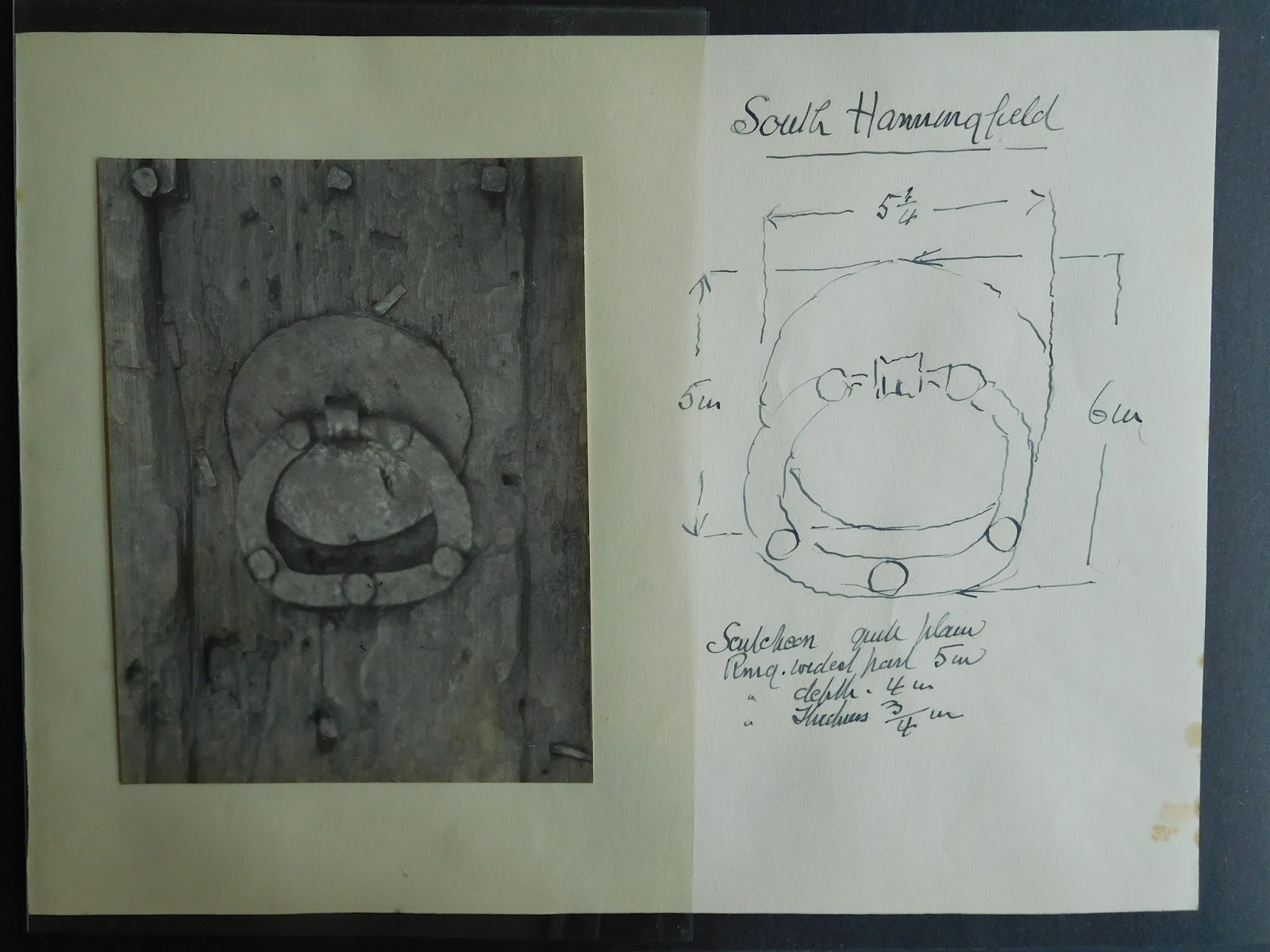
The Essex Society for Archaeology and History continues the online publication of Fred Brand's photographs of Essex church door closing rings from the 1930s, which has recently been received and assigned reference S/LIB/9/51 in the archives.

These examples are from Southchurch, South Hanningfield and Stock.


Saturday, 2 April 2016

London Museum of Water and Steam, Brentford


This item may be of interest to members of the Essex Industrial Archaeology Group:

"I am contacting you from the London Museum of Water and Steam in Brentford, home to the largest collection of water pumping engines in the world. With a collection of seven working water pumping engines including the world largest steam powered engine in operation we are a truly unique site.


"The London Museum of Water and Steam welcomes groups every year from all over Britain and indeed the world. We are able to offer a discounted rate to visiting groups, and in order to qualify for our discounted rate groups must consist of 10 visitors or more.

"Self-led group visit:  £7.50 per person

"Guided tour:  £8.50 per person

"Anna Chrystal
Education and Outreach Officer

London Museum of Water and Steam
Green Dragon Lane
Brentford
TW8 0EN

Sunday, 27 March 2016

Some Essex Closing-Rings 5

Fred Brand's project from the 1930s to locate closing rings on ancient Essex church doors. These examples are all from Saffron Walden, and are published by the Essex Society for Archaeology and History for the first time.


Tuesday, 22 March 2016

Colchester Castle Museum: Fenwick Treasure on Public View from 24 March 2016

Fenwick Treasure set to be unveiled at Colchester Castle


The Fenwick Treasure is set to be unveiled to the public from Thursday 24 March 2016.
Visitors to the Castle will be able to view first hand a fascinating display of these captivating archaeological finds, which are of international significance. The objects and their stories really bring the vivid tale of the Boudican uprising to life. Find out more about making a visit here: www.cimuseums.org.uk/fenwickhoard
treasure

Monday, 21 March 2016

High Country History Group: Zeppelins Over Essex, 31 March 1916. Thursday 31 March 2016.

Zeppelins over Essex: 31 March 1916

Blackmore residents had a very close shave a hundred years ago when the German Zeppelin L14 dropped bombs in the parish.  The stained glass in what is now the kitchen of St Laurence Church commemorates the night with these words: “This window is erected as a thank-offering to Almighty God for the protection in the Great Air Raid of March 31st 1916” (see illustration).

Andrew Smith has researched what happened that night and tells the story in a presentation to be given to the High Country History Group on 31 March 2016 (8pm Toot Hill Village Hall), and this summer at the Friends of St Laurence Church Blackmore AGM.
  
The Rector of Stondon Massey, Revd. Reeve recorded details in his ‘Notes for a Parish History’:  He lived at the Rectory, what is now Stondon Massey House.

“At 11.45[p.m.] a Zeppelin dropped a series of bombs at the point where is the junction of Stondon with the parishes of Blackmore and Kelvedon Hatch: within easy distance of Soap House Farm.  A machine-gun had been lately established at Kelvedon Hatch to watch for the raiders … causing it to drop the bombs hurriedly.

“Large numbers of persons from Brentwood and the surrounding district visited the spot next day, and the large craters caused by the bombs, some 15 feet in diameter and varying from 3 to 9 feet in depth, were the astonishment of all.  The whole saucer-like cavities were left entirely clean by the explosion. … Nine of the thirteen holes were quickly found: and fortunately no life was lost or building injured. … Our windows at Stondon Rectory were violently shaken and considerable alarm was naturally caused.

“Further enquiry shows that the bombs dropped on March 31st fell between the Soap House and the corner of Blackmore between the Church and Miss Barrett’s house.  Two were dropped in the lane near the site of the old Blackmore Mill.  The remaining holes were to be found in a straight-line across the fields to Miss Barrett’s at very short intervals.  Many panes of glass were broken in the house by the concussion.”


Four people were killed in Braintree that night by the same Zeppelin crew.  To hear the full story come along to Andrew’s talk.

Sunday, 20 March 2016

Some Essex Closing-Rings 4

Some Essex Closing Rings


This is the title of an unpublished portfolio of photographs taken by Fred Brand and S E Lloyd, sent to Revd. G Montagu Benton in 1935.  These examples are from Little Totham, Little Waltham and Purleigh. 


Thursday, 17 March 2016

Book Sale at Morant Lecture: 19 March 2016

Members coming to the Morant Lecture at Stebbing this Saturday will be able to browse and buy the latest selection we have of surplus books.  To see the list go to www.blackmorehistory.co.uk/esah.html

Wednesday, 16 March 2016

Philip Morant (1700-1770)

The biography of Philip Morant (1700-1770), written for the dedication of memorials to the Essex historian on 15 March 1966.

PHILIP MORANT, younger son of Stephen Morant and Mary nee Filleul, was born in the St. Saviour's parish, Jersey, on the 6th October, 1700.

Proceeding from the Grammar School, Abingdon, Berks., he matriculated at Pembroke College, Oxford, 17th December, 1717, and was admitted to the degree of Bachelor of Arts, 21st September, 1721. Although Philip Morant passed for the Master of Arts degree at Oxford he arranged to be incorporated at Sidney Sussex College, Cambridge, taking his M.A. from that University, 10th October, 1729.

By Letters-commissory from the Bishop of London the Bishop of Norwich admitted him to Deacon's Orders, at St. Martin's-in-the-Fields, Westminster, on 23rd September, 1722. Edward  Gibson, Bishop of London, ordained him Priest,  20th  December,  1724.                                                                                           ·

From September 1722 till August 1732, Nicholas Tindal, Vicar of Great Waltham, was assisted in his cure by the young Morant, as the account books of the Black Chapel show, but then Caroline, Queen Regent, nominated him to the chaplaincy of the English Episcopal Church at Amsterdam.

In quick succession there followed these preferments:
Rectory of Shellow Bowells.  From 20 April 1733, to November 1734
Rectory of Broomfield: From 17 January 1734, to April 1738
Rectory of Chignal Smealey: From 19 September 1735, to April 1743
Rectory of St. Mary's, Colchester: From 9 March 1738, to April 1770
Rectory of Wickham Bishops: 21 January 1743, to October 1745
Rectory of Aldham: from 14 September 1745, to October 1770.

In November,  1735, Mary, Dowager Countess of Cassillis, appointed  him her private chaplain.   Never did he hold more than two benefices at one time.

On 6th February, 1739, he married Anne, daughter of  Solomon  Stebbing of the  Brook  House,  Great Tey. Their only daughter, Anna Maria, was born 25th November, 1739; she afterwards married Thomas Astle, Keeper of the Records in the Tower.

When Mrs. Morant died, 20th July, 1767, aged 69, Morant moved to his daughter's home at Battersea Rise, London, and it was while returning by water from the Temple to Vauxhall, en route for South Lambeth, that he caught the chill from which he died, 25th November, 1770. He was buried beside his wife in the Old Church at Aldham and the stone marking that spot is now re-erected in the present Aldham Church with the Tablet presented by the Society near to it.   In the chancel of the Aldham church is the Latin Epitaph penned by Thomas Astle, his son-in-law, while the east window of the church was placed there as a memorial to his memory in 1854.

It was on 20th November, 1755, that the Historian of Essex was elected to the Fellowship of the Society of Antiquaries of London. He had published his History of Colchester in 1748 and was preparing The History and Antiquities of Essex, 2 vols., folio, 1760-1768.

The Essex Archaeological  Society has cared for the grave of the historian for some years now but so that the stone might be preserved was pleased to assist in saving this by placing it in the present Aldham Church. To mark his long association with the Borough of Colchester an armorial tablet is placed in the church of St. Mary-at-the Walls, Colchester.                                                          ·

Aldham's Church of Morant's day and the former Rectory of St. Mary-at-the-Walls, Colchester, have been demolished but work which the historian initiated goes on and almost two hundred years after his death his hand still  guides  researchers.

JOHN S. APPLEBY, F.R.Hist.S.
Hon. Secretary, E.A.S.

Tuesday, 15 March 2016

Morant Anniversary.

Morant Commemorations Fifty Years Ago


From the Society’s Annual Report 1966: “The work of the Revd. Philip Morant, M.A., F.S.A., was further remembered by the events of Tuesday, 15th March, 1966, when, at Aldham Church, The Patron of the Society [Sir John Ruggles-Brise] unveiled a memorial tablet in Stone, commemorating the removal of the tombstone of the historian and his wife from the older churchyard to the sanctuary of the present church. At St. Mary-at-the-Walls Church, Colchester [now Colchester Arts Centre] Sir John Ruggles-Brise, unveiled a carved memorial tablet of oak; this tablet, bearing the arms of Morant, is placed in the tower entrance. The Rt. Revd. Dr. Roderic Coote, Bishop of Colchester, Vice-President of the Society, dedicated the tablets. The Revd. C. Philip Gilman, Rector of Aldham, and the Revd. Ralph Stevens, Rector of St. Mary-at-the-Walls, conducted the services in their respective parishes. The Orders of Service [now available in digital format] included a biography of Morant written by the Hon. Secretary [John Appleby].”

Monday, 14 March 2016

Morant Lecture at Stebbing. Saturday 19 March 2016

Friends Meeting House, Stebbing
The next meeting of the Essex Society for Archaeology and History will be held at 2pm on Saturday 19 March 2016. The venue: The Friends Meeting House, Stebbing.  This will be the annual Morant Lecture held in honour of the great Essex historian.  It will be a talk about the village of Stebbing and the various projects that are happening, followed by a tour of the village then refreshments.  Stebbing is a small village in north Essex situated to the north of the Roman road - Stane Street. Stebbing has a Grade I listed church and the earthworks of a medieval castle.

Sunday, 13 March 2016

Some Essex Closing-Rings 3

Some Essex Closing Rings


This is the title of an unpublished portfolio of photographs taken by Fred Brand and S E Lloyd, sent to Revd. G Montagu Benton in 1935.  In February 2016 it was given to the Society by the family of the late Kenneth Mabbitt and added to our archives pro tem (as S/LIB/9/51).  Thirty-one items have been digitised, 29 of which are photographs of closing rings on Essex church doors with a sketch showing measurements alongside. Frederick Joseph Brand (1857-1939) had been a member of EAS since 1899. His obituary appeared in TEAS n.s. 23, p192-195, in which Benton mentions his enthusiastic interest in the topic. “He was engaged on this survey, which was nearing completion, practically up to the outbreak of war”.  He took many photographs on the Society’s excursions and was “usually the last to regain his seat on the motor-coach”.  Stanley E Lloyd, of Goodmayes, has been a member of EAS since 1923. 

Examples here from Great Yeldham, Hempstead and Heybridge.


Sunday, 6 March 2016

Some Essex Closing-Rings 2

Some Essex Closing Rings

This is the title of a portfolio of photographs taken by Fred Brand and S E Lloyd, sent to Revd. G Montagu Benton in 1935.  In February 2016 it was given to the Essex Society for Archaeology and History by the family of the late Kenneth Mabbitt and added to our archives pro tem (as S/LIB/9/51).  Thirty-one items have been digitised, 29 are photographs of closing rings on Essex church doors with a sketch showing measurements alongside. Frederick Joseph Brand (1857-1939) had been a member of EAS since 1899. His obituary appears in TEAS ns XXIII p192-195, in which Benton mentions his enthusiastic interest in the topic. “He was engaged on this survey, which was nearing completion, practically up to the outbreak of war”.  He was often busy taking photographs on the Society’s excursions and “usually the last to regain his seat on the motor-coach”.  Stanley E Lloyd, of Goodmayes, has been a member of EAS since 1923.

Illustrated here: East Horndon, Eastwood, Elsenham, Great Waltham.


Monday, 29 February 2016

Jaywick Martello Tower: Visited 26 February 2016

In defence of the vulnerable East Coast during the Napoleonic Wars, 29 Martello Towers were built between Brightlingsea and Aldeburgh. Jaywick is ‘Tower C’ but was beset with difficulties during construction owing to the marshy land and sank five feet into the ground.  It took three years to complete and when finished in 1812 the war was over.  

It contains 750,000 bricks which came from Grays and were landed on the beach by flat bottomed barges. Construction could only be done during the summer months because of the difficulties in using lime mortar.  

Access was originally to the first floor, the living quarters designed for 24 musketeers. The ground floor was for storage of supplies, food and ammunition sufficient for a month’s stay.  Many soldiers stayed at Weeley Barracks a few miles away.  The open top, the gun deck, once held three 24lb cannons and three howitzers.  The glass cabin is a later addition intended as a coastguard lookout.  

Thirty-eight members of the Essex Society for Archaeology and History attended this Friday lunchtime meeting.  Now a museum, Jaywick Martello Tower is open during the summer months.

Sunday, 28 February 2016

Some Essex Closing-Rings 1

Some Essex Closing Rings

This is the title of a portfolio of photographs taken by Fred Brand and S E Lloyd, sent to Revd. G Montagu Benton in 1935.  In February 2016 it was given to the Essex Society for Archaeology and History by the family of the late Kenneth Mabbitt and added to our archives pro tem (as S/LIB/9/51).  Thirty-one items have been digitised and will be posted on the blog, 29 of which are photographs of closing rings on Essex church doors with a sketch showing measurements alongside. Frederick Joseph Brand (1857-1939) had been a member of EAS since 1899. His obituary appears in TEAS ns XXIII p192-195, in which Benton mentions his enthusiastic interest in the topic. “He was engaged on this survey, which was nearing completion, practically up to the outbreak of war”.  He was often busy taking photographs on the Society’s excursions and “usually the last to regain his seat on the motor-coach”.  Stanley E Lloyd, of Goodmayes, has been a member of EAS since 1923.  The portfolio folder has a small disc tied to it: “[Re]eman Dansie / Auctioneers / Colchester / 260”.  Their auction house was once in East Hill, very close to where Mabbitt lived. Whether the item was purchased by Mabbitt at auction after Benton’s death in 1959 is not clear.

Illustrated here:
Chignal Smealey, Great Bromley, Buttsbury (two examples).


Friday, 19 February 2016

Building the Wireless Age. Major Marconi Exhibition this Spring in Chelmsford

Building the Wireless

A Unique Marconi Exhibition at The Original Marconi Wireless and Telegraphy Works in Hall Street, Chelmsford, the World's first wireless factory which Marconi established in 1898. 

Marconi Science WorX: Chelmsford Civic Society in collaboration with BBC Essex.

Open 11th March to 29th May 2016
Every Sat. & Sun. 11.00am - 3.00pm
Free entry

LATEST UPDATE! Oyez Oyez - Tony Appleton, the Town Crier, will open the Marconi Exhibition to the public on Friday 11th March at 11.00 and Peter Turret Chairman of Marconi Veterans Association, will be there to show visitors around until midday and to answer any questions.

Tim Wander, curator. Marconi historian and author, will speak on 'Hall Street and Marconi: Building the Wireless Age' on Friday 18th March at 7pm - tickets £5. Tim's book 'Marconi's Hall Street Works: The World’s First Wireless Factory' is made possible by a grant from Essex Heritage Trust with proceeds from book sales going towards the exhibition.

Dave Monk. BBC Essex well-known broadcaster, will speak on ‘The BBC and Me and his life behind the Mike!' on Fri 25th March at 7pm - FREE but please book on Eventbrite.

Ray Clark. broadcaster and author - Friday 1st April at 7.00 – ‘All at Sea' - the exiling story of offshore Radio Caroline the true story of the boat that rocked - FREE but please book on Eventbrite.

ADVANCE NOTICE: In May there will be a BIG BBC ESSEX WEEKEND and a double event by Prof. Danielle George with permanent static displays throughout March, April and May courtesy of The International Marconi Museum, Bologna, Essex Record Office, Tim Wander and much more.

To book tickets please visit www.chelmsfordcivicsociety.eventbrite.com - proceeds from tickets and books will pay for setting up the exhibition.


Wednesday, 17 February 2016

Occasional Paper: Excavations Along the M25. Prehistoric, Roman and Anglo-Saxon Activity between Aveley and Epping, Essex

The Essex Society for Archaeology and History is pleased to announce the publication of its new Occasional Paper, written by Edward Biddulph and Kate Brady, with contributions from several others.  Currently available only to members, who should have received copy by now, it will go on sale to the public, price £12.50 including P&P to UK address, after Easter. (Membership, including all the year's publications starts from £20.)

Archaeological fieldwork by Oxford Archaeology at some 29 sites along the route of a widening scheme between junctions 27 and 30 of the M25 motorway in Essex uncovered evidence of past occupation and activities dating from the Mesolithic to post-medieval periods.

Late Iron Age cremation burials, Roman-period enclosures and field boundaries, and a tentatively identified Anglo-Saxon sunken-featured building were discovered at Hobbs Hole at Junction 29 of the M25. At Passingford Bridge, Stapleford Tawney, a middle Bronze Age ring-ditch, possibly a barrow, was recorded in the floodplain of the River Roding. Evidence was found of a middle Iron Age to Roman farming settlement of roundhouses, enclosures and raised granaries, established on the higher ground of the gravel terrace. An alignment of irregular pits dated by pottery to the early-middle Iron Age was uncovered near Upminster, and early Saxon charcoal-filled pits — evidence, possibly, of charcoal-burning — were recorded at Codham Hall near Great Warley.


The limited opportunity for archaeological excavation during the original construction of the motorway meant that little had been known of the archaeology beneath. The results presented in this volume have significantly altered that view, revealing a picture of an evolving cultural landscape between Aveley and Epping from prehistoric to modern times. 

Tuesday, 16 February 2016

Next Visit: Jaywick Martello Tower, 26 February 2016

Members of the Essex Society for Archaeology and History will be visiting Jaywick Martello Tower on Friday 26 February 2016 at Noon.  The visit will consist of a guided tour of the tower and talk about its history, followed by refreshments. The Tower was built in 1810 along with 29 other towers along the East Coast. The bricks came from Grays and were transported by barge.

Sunday, 14 February 2016

Roman Arcade in Colchester Displayed: Note on Previous Excavations

Colchester Archaeological Trust’s one-day display of the Monumental Roman Arcade which acted as the gateway to the Temple of Claudius (on 13 February 2016, at 97 High Street, Colchester) had attracted over 650 members of the public by lunchtime.  The site will be glazed over by its owners, Flying Trade Group plc, opening a café on the ground floor site this summer.  The largest Arcade in Britain was originally discovered in the 1930s. Excavations had previously been carried out on the Kent Blaxill site in 1953, published in the Society’s Transactions (New Series, Vol. 25, pp24-61) and on the neighbouring plot at 98-99 High Street in 1964, also published by the Society (Third Series, Vol. 3, pp115-130). 

The illustration is taken from M. R. Hull's report.

Further reading:
Hull, M.R. ‘The South Wing of the Roman ‘Forum’ at Colchester: Recent Discoveries’ (TEAS, n.s. 25, 1955)

Hebditch, Max. ‘Excavations on the South Side of the Temple Precinct at Colchester, 1964’ (TEAS, Third Series 3, 1971)

Archaeological Site open to the Public: Colchester Archaeological Trust show Roman Arcade to front of Claudius Temple (now site of Castle)

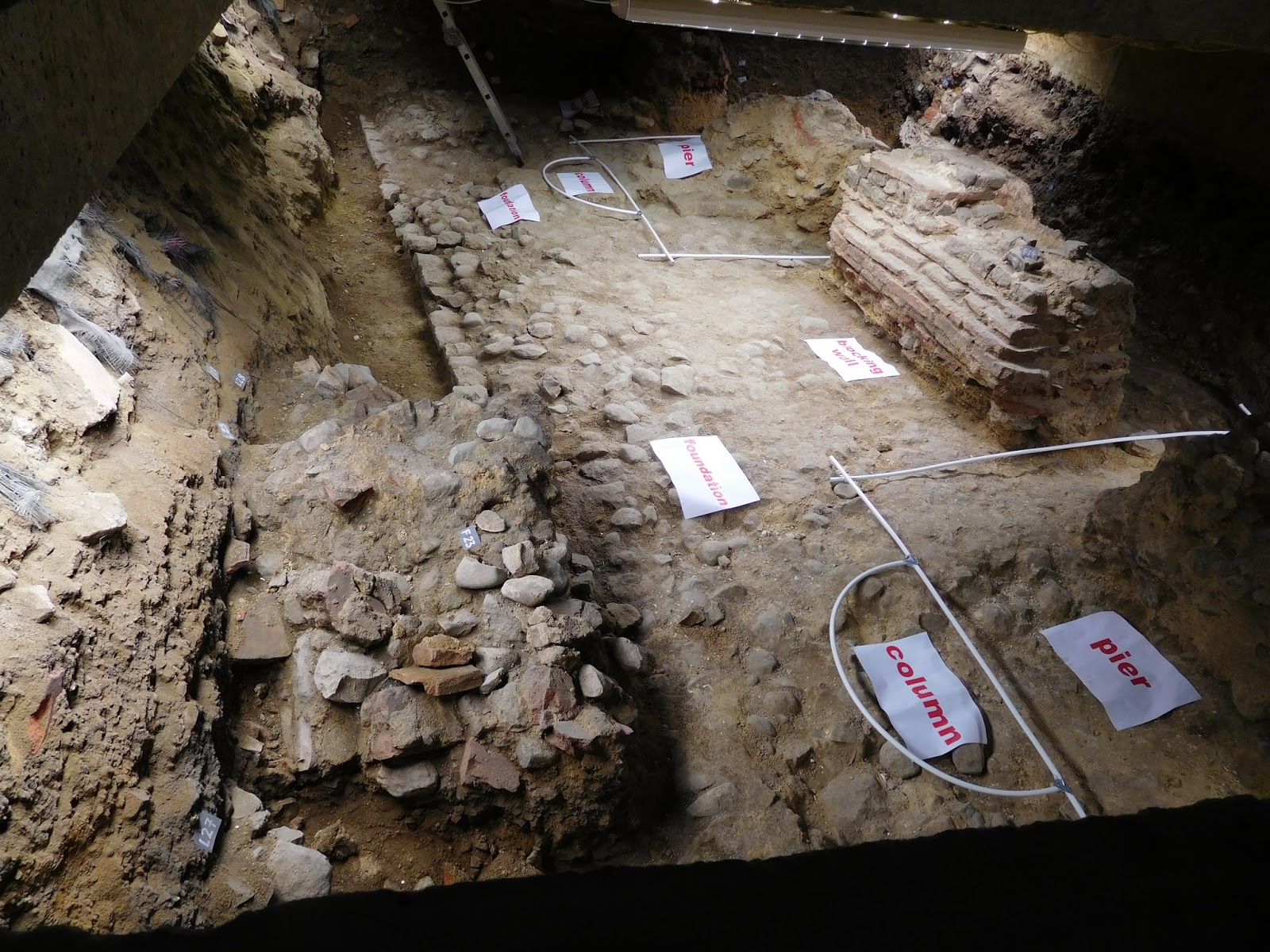
Colchester Archaeological Trust's monumental excavation at 97 High Street, Colchester was shown to the public for the first time yesterday (13 February 2016).  On a rather dank and drizzly day about 650 people had visited by lunchtime.  Andrew Smith, a member of the Essex Society for Archaeology and History (and Friends of the Trust member), infiltrated the crowd to bring these photographs.
The Trust's website reported that, "The monumental arcade made it into local, national and even international media outlets! The Trust has exposed some of the massive foundations of the Roman monumental arcade which once fronted the precinct of the Temple of Claudius in Colchester, at 97 High Street, and the site owners had kindly given permission for us to open the site to visitors for a day. The site owners are Flying Trade Group plc: they are also going to install a cafe on the ground floor of the building which now stands over the exposed foundations, and this will include large ‘windows’ in the floor so that customers can view the remains, which will be a marvellous addition to the heritage of the town."
The local firm, who have built flats on the site, is forgoing the sale of the ground floor space so that visitors can see the archaeological remains. 
"Philip [Crummy, the Trust's director] thinks that these remains represent the largest Roman arcade in the northern Roman empire, as the remains which were recently discovered – of the largest Roman arcade in France – represent a smaller structure than the arcade in Colchester. The arcade in Colchester seems to have been 120 metres long. (The remains of the smaller arcade were discovered in 2014 at Pont-Sainte-Maxence.)"
The excavation and the Open Day was reported in The Times newspaper and also into The Sun on 11 February. The East Anglian Daily Times gave it a three-page spread, which was a great response.
C.A.T. posted the following media links:
* The links to the online press reports:
10th February:

‘”Largest Roman arcade” in Britain to go on show in Colchester’, atwww.bbc.co.uk/news/uk-england-essex-35540347
‘Extraordinary Roman arcade found in Colchester is “greatest find of its kind”, atwww.eadt.co.uk/news/extraordinary_roman_arcade_found_in_colchester_is_greatest_find_of_its_kind_1_4412792
‘Enormous Roman arcade found in Essex was once part of a magnificent temple: 400ft-long arched structure is the largest of its kind found in the UK’, atwww.dailymail.co.uk/sciencetech/article-3440402/Enormous-Roman-arcade-Essex-magnificent-temple-400ft-long-arched-structure-largest-kind-UK.html
‘Remains from Britain’s largest Roman arcade from the Temple of Claudius to go on show on Saturday’, at www.gazette-news.co.uk/news/14265990.Remains_from_Britain_s_largest_Roman_arcade_to_go_on_show_on_Saturday/
‘Colchester’s monumental Roman arcade uncovered’, at www.archaeology.org/news/4143-160210-england-roman-colchester
‘Britain’s biggest Roman arcade discovered under a block of flats in Essex, athttp://news.yahoo.com/britains-biggest-roman-arcade-discovered-under-a-145407741.html
11th February:

‘Colchester Roman remains to be displayed’, atwww.dream100.com/news/index.php?storyid=44784&s=5
‘Remains of monumental Roman arcade discovered in Colchester’, atwww.thehistoryblog.com/archives/40642
‘Monumental Roman arcade found in Britain’, atwww.archaeology.wiki/blog/2016/02/11/monumental-roman-arcade-found-britain/
.

Thursday, 11 February 2016

Important Archaeological Site in Colchester High Street open for One Day only: Saturday 13 February 2016. 10am 4pm

News from Colchester Archaeological Trust:

The Trust is delighted to announce that we will be holding a site open day on Saturday 13th February 2016, at 97 High Street in Colchester. Our clients – Flying Trade Group plc – have very kindly agreed to open their construction site to visitors for the day. This is an extremely important archaeological site, where we have been investigating the massive foundations of the monumental Roman arcade which originally fronted the precinct of the Temple of Claudius. The arcade is unique in Britain and Trust director Philip says that these foundations represent the largest Roman arcade in the northern Roman empire. We have exposed about 13 metres of the arcade’s foundations and visitors will be able to view these, specially labelled and illuminated for the day! We will also be projecting a video of the new 3d-modelling of the arcade which has been created for the Trust by local designer Roger Massey-Ryan.
The Temple of Claudius was the only Roman temple dedicated to an imperial cult (that of the emperor Claudius) in Britain: it was built in about AD 54. (The emperor Claudius came to Camulodunum – the Iron Age precursor of Colchester – during the Roman invasion of Britain in AD 43.) Colchester Castle is built on the foundations of the temple and the temple door would have faced this frontal arcade. A fragment of the temple precinct wall can be seen in Castle Park. The arcade may have been built at the same time as the temple or in the late 1st-early 2nd century AD. The remains of the arcade were first discovered in 1953, but our current investigations of the foundations have been extensive and revealing… The remains of the temple and the arcade are remarkable. We are also very interested in the Temple of Claudius and its arcade because, on chariot-racing days, a large religious procession or pompa – including the chariots and horses – would have travelled from the temple to the Roman circus before the start of the races. The temple precinct here would have been like the Forum in Rome, and a very busy space, with people going to and from the temple and, possibly, with market stalls and crowds of people shopping and socialising. They would have entered the precinct through the archways of the arcade. The temple and the arcade may have been still standing at the time of the Norman invasion of England and only demolished then… (Read more about the arcade on this web-site at www.thecolchesterarchaeologist.co.uk/?p=13840.)
The site will be open from 10.00am until 4.00pm and admission is free. Trust archaeologists, excavators and volunteers will be there to direct visitors and to chat, and Trust director Philip and Trust deputy director Howard will be there all day to explain the site and the exposed foundations to our visitors in small groups. If you would like to visit the site, then we would ask you to go into the Castle Park and to the new park gate, almost opposite the castle entrance, which gives access to the rear of 97 High Street (‘Castle House': postcode CO1 1UG). The site is wheelchair-accessible. We look forward to seeing you!
The surviving foundations of the Temple of Claudius can be viewed within Colchester Castle Museum. The remains of the Roman theatre in Maidenburgh Street – inside a house not far from 97 High Street – will also be open to visitors for the day: the theatre would have formed part of a complex with the temple and precinct.