A Lorenz teleprinter has been sold from an Essex shed for £10. For more see http://www.npr.org/sections/thetwo-way/2016/05/29/479943359/museum-finds-piece-of-wwii-history-for-sale-on-ebay
Monday, 30 May 2016

Sunday, 22 May 2016
Transactions. Series 4. Volume 5

Essex Society for Archaeology and History
Transactions. Fourth Series. Volume 5 (2014)
(220 pages)
Contents:
An Early Bronze Age Beaker domestic site: Excavations at 105-109 New Road, Rainham, London Borough of Havering: R Bull … 1
A Prehistoric landscape at Langford Hall, near Heybridge: Excavations 1995-96: M Roy & E M Heppell … 19
Excavations at Earls Hall Farm, St Osyth: Nuala C Woodley … 37
Continuity and change in the mid Chelmer Valley – archaeological excavations at Old Hall and Generals Farm, Boreham, 2007: M Germany … 45
A Late Iron Age red hill and saltern at Bradwell on Sea: T Ennis … 103
Late Iron Age, Roman and medieval occupation at Letch’s Yard, 109 High Street, Braintree: T Ennis … 103
The gardens at Moulsham Hall: Excavations at Princes Road, Chelmsford, 1996-97: E M Heppell … 118
The stationary steam engine in Essex before 1840: A Phillips … 133
Historic Buildings in Essex (Essex Historic Buildings Group): Essex Tree-Ring Dates; Aveley St Michael; Sheering Church Nave Roof; Baythorne Hall, Birdbrook. A Raised Aisle Hall Manor House built in 1341; The Stockwell Restaurant, the former Stockwell Arms Public House, Colchester; Bullocks Cross, Coggeshall; Parsonage Farm, School Lane, Broomfield, Chelmsford; The Listed Barns at Coleman’s Farm, Theydon Mount: David Andrews … 142
Heybridge Hall and the Freshwater family: K Bruce … 182
Ancient and modern, developing landscape of South Essex: A review of four recent monographs: (i) Landscape and Prehistory of the East London Wetlands: investigation along the A13 DBFO road scheme, Tower Hamlets, Newham and Barking & Dagenham, 2000-2003 by Elizabeth Stafford with Damian Goodburn and Martin Bates, 2012; (ii)By River, Fields and Factories: The Making of the Lower Lea Valley: archaeological and cultural heritage investigations on the site of the London 2012 Olympic and Paralympic Games by Andrew B Powell, 2012; (iii) London Gateway, Iron Age and Roman Salt Making in the Thames Estuary: Excavation at Stanford Wharf Nature Reserve, Essex by Edward Biddulph, Stuart Foreman, Elizabeth Stafford, Dan Shanbie & Rebecca Nicholson, 2012; (iv) Thames Holocene: A geoarchaeological approach to the investigation of the river floodplain for High Speed 1, 1994-2003 by Martin Bates and Elizabeth Stafford, 2013: Nigel Brown … 190
Shorter Notes
A possible Roman tile kiln at Prentice Place, Carters Mead, Harlow: S Mounce & P Bradley … 200
The misplaced masterpiece – a reassessment of the Berryfield mosaic [Colchester}: P J Wise … 202
‘New’ Anglo-Saxon charters of Barking Abbey: J Kemble … 204
Collegium Chronologicum: H Eiden … 210
Book Reviews
The Red Hills of Essex: Studying Salt in England: Anwen Cooper … 212
Elizabeth de Burgh, Lady of Clare (1295 – 1360). Household and other records: Katherine Schofield … 214
Beeleigh Abbey: A Guide and History : Christopher Starr … 214
The Borough of Maldon 1688-1800. A Golden Age: Christopher Starr … 215
Bricks, Buildings and Transport. A History of Mark Gentry, the Hedingham Red Brick Industry, Buildings, Road, and Rail Transport: David Andrews … 215
A Caring County? Social Welfare in Hertfordshire from 1600: Herbert Eiden … 216
Essex Bibliography: Andrew Phillips & Paul Sealey … 217
Thursday, 21 April 2016
West Essex Archaeological Group. Events
SUMMER EVENTS
WEST ESSEX
ARCHAEOLOGICAL GROUP
Monday 9th
May
Rudge Memorial
Lecture: ‘The Thames at War’, illustrated talk by Gustav Milne, Museum of
London Archaeology, 7.45 p.m., School Hall, Woodford County High School, High
Road, Woodford Green. Free entry and
refreshments.
16 – 17; 23 – 24; and
30 – 31 July: Excavation Taster Weekends at Copped Hall near Epping, aimed at complete
beginners. For more information and
bookings, visit www.weag.org.uk
13 – 17 and 27 -31
August: Five-Day Field Schools, ongoing excavation of Tudor grand-house at
Copped Hall, near Epping. For full
details and bookings , visit www.weag.org.uk
Wednesday, 20 April 2016
Gaps in 'Current Archaeology'? We can help.
Current Archaeology. We have received a complete run of Current Archaeology from #1 to #302 (May 2015) which we do not need for our Library. Do you have gaps on your bookshelf or does your archaeological or historical institute, university or group have the same problem? Each item only 30p + P&P. Contact us. We might be be able to help.
Monday, 18 April 2016
Newsletter (Spring 2016)
The Spring 2016 edition of the Newsletter (NL177) arrived through the post for many members of the Essex Society for Archaeology and History on Saturday. Readers will immediately notice that the front cover is different, illustrating six Roman coins which were stolen from Chelmsford Museum in January 2016 and remain, alas, unrecovered. Why someone would steal these is a question that does not warrant comment, other than to reflect what the curator of the Fitzwilliam Museum Cambridge said in response to the jailing of the gang responsible that the Chinese artefacts, not found, belonged in a sense to everyone.
The Newsletter is another 24-page edition, the contents of which include:
- From The President. Adrian Corder-Birch mentions that 'Excavations along the M25', occasional paper is available to members with additional copies on sale to the public; the work of Philip Crummy and Colchester Archaeological Trust in connection with the Fenwick Treasure, now on display at Colchester Museum, and excavations of the Roman arcade in the High Street; and, the forthcoming Annual General Meeting to be held at the Castle. (Papers will be circulated separately.)
- Coins Stolen from Chelmsford Museum
- Heritage Crime Investigation Rumbles a Dutch Deception
- A Vengeful Saint
- Essex Utopias?
- Society Visit to Jaywick Martello Tower, 26 February 2016
- John Booth, Essex Antiquary - a postscript
- Roman Arcade Attracts A Crowd
- Harlow Temple Digitisation Project: an update
- Excavations at Pleshey
- Henry VIII's Jericho?
- Major Brinson's Italian Excavations
- Eddington Engineering in Chelmsford
- Archaeologists explore Envrironment Agency's LIDAR
- The Society Archives: The Sellers give us the Sixties
- ESAH Finds New Home for Pottery Fragments
- Essex Churches Project
- Essex seen from Elsewhere
- Library Purchases and Donations
- Vernacular Architecture
- The Meaning of Mucking
- Events In Essex
- Readers Letters
- Essex Journal
- Book Reviews
Sunday, 17 April 2016
Some Essex Closing-Rings 8
Concluding the series of photographs presented to the Revd. G Montagu Benton by Fred Brand in 1935 of Essex closing-rings on church doors, these examples come from White Roding (White Roothing), Widdington and Witham.


Friday, 15 April 2016
Fenwick Hoard Resources - Colchester & Ipswich Museums
Fenwick Hoard Resources - Colchester & Ipswich Museums Teaching resources now available
Tuesday, 12 April 2016
The Hyde, Ingatestone: Eulogy For A Country House School

The Hyde, Ingatestone, was the
seat of John Disney the first President of the Essex Society for Archaeology
and History. During the twentieth
century until gutted by fire it was a school.
EULOGY FOR A COUNTRY HOUSE
SCHOOL
From David Archer Wright:
Discovering this article and
other references to The Hyde Ingatestone, immediately evoked suppressed
memories of long past familiarities.
As country houses go, The
Hyde, although by no means architecturally outstanding, was certainly a
property worth cataloguing. The splendidly re-structured Palladium style great
hall with finely turned Tuscan columns and grand sweeping staircase, even
during latter day school use, was impressively adorned with fascinatingly
complementing period artefacts: time
dulled oil paintings in ornate guilt frames, dusty doe eyed stag's heads,
stuffed owls in glass domes and a fine eighteenth century long case clock.
As a pupil spending my
formative years here, I also recall the rows of servants' bells in the lengthy
corridor leading between lofty kitchens and wood panelled dining room,
summoning past eras of wealthier times.
Privileged highlights amidst
the dull chalk dusted lessons were officially escorted introductions to the
dizzying heights of the rooftop balustrades or the dark dank depths of the
cellars. In the stable block heavy archaic accumulators were clues to an
earlier, more prosaic source of electricity.
Most exciting of all was a
secret room entered by way of an opening bookcase, its subtly hinged shelves
lined from floor to ceiling with false leather bound first editions. The wide
oak floorboards in front of the books maintained a highly lustred finish with
the enthusiastic aid of fleet footed boys organised into skating parties,
fiercely sliding up and down in outsized football socks. In a room on the third
floor (no doubt out of bounds) silent stacks of redundant cast iron bedsteads
remained as inherited evidence of the house's use as a military hospital during
WWI.
The date 1719 is for some
reason embossed on my memory as surely as it was on the cast iron tops of
guttering down pipes beside certain bricked up windows.
As a school, typical 'Basil
Fawltyesque' ideology was nurtured from an early age; high moral values
indoctrinating tender young minds. We were systematically encouraged to feel
pride in being British: superior. Psychology was a load of tommy rot. Anyone speaking with a regional accent was a
yob. Break times in the shrubbery provided initiation and intensive instruction
into the extra curricula activities of fighting smoking and bullying.
The greatest tribute payable
to the Hyde School, its highest possible accolade, most praiseworthy of
progenies and ultimate achievement, is the fact that it was burnt down. It
bequeaths a legacy of ploughed up arable fields.
Sunday, 10 April 2016
Some Essex Closing-Rings 7
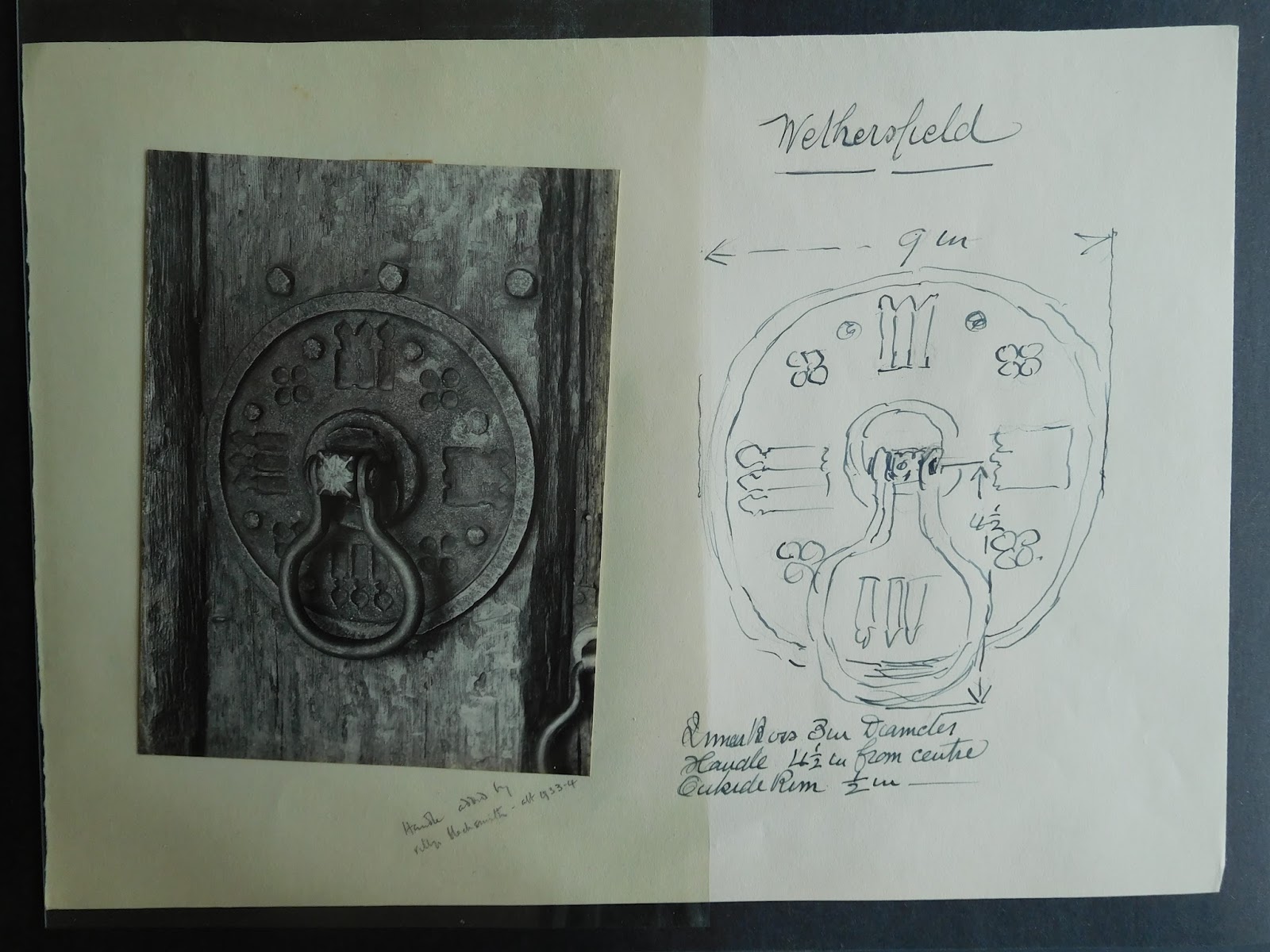
Continuing the series of Essex Closing-Rings photographed by Fred Brand in the 1930s. These examples are from the churches at Takeley, Terling, West Hanningfield and Wethersfield.


Tuesday, 5 April 2016
Zepfest Film Presentation: Friday 8 April 2016
Zepfest
The forced landing of the German Zeppelin L33 at 1.20am
on 24 September 1916 at Little Wigborough is commemorated by Zepfest (http://www.zepfest.net/#home ), now
National Trust property, on Saturday 24 and Sunday 25 September 2016. Tickets for the main event go on sale in due
course.
In the meantime, on Friday 8 April 2016 starting at
7.30pm at Abbotts Hall Meeting Room, Great Wigborough, CO5 7RZ, there will be a
film presentation. For more see http://winstred100.org/2016/03/zepfest-film-presentation/
Sunday, 3 April 2016
Some Essex Closing-Rings 6
The Essex Society for Archaeology and History continues the online publication of Fred Brand's photographs of Essex church door closing rings from the 1930s, which has recently been received and assigned reference S/LIB/9/51 in the archives.
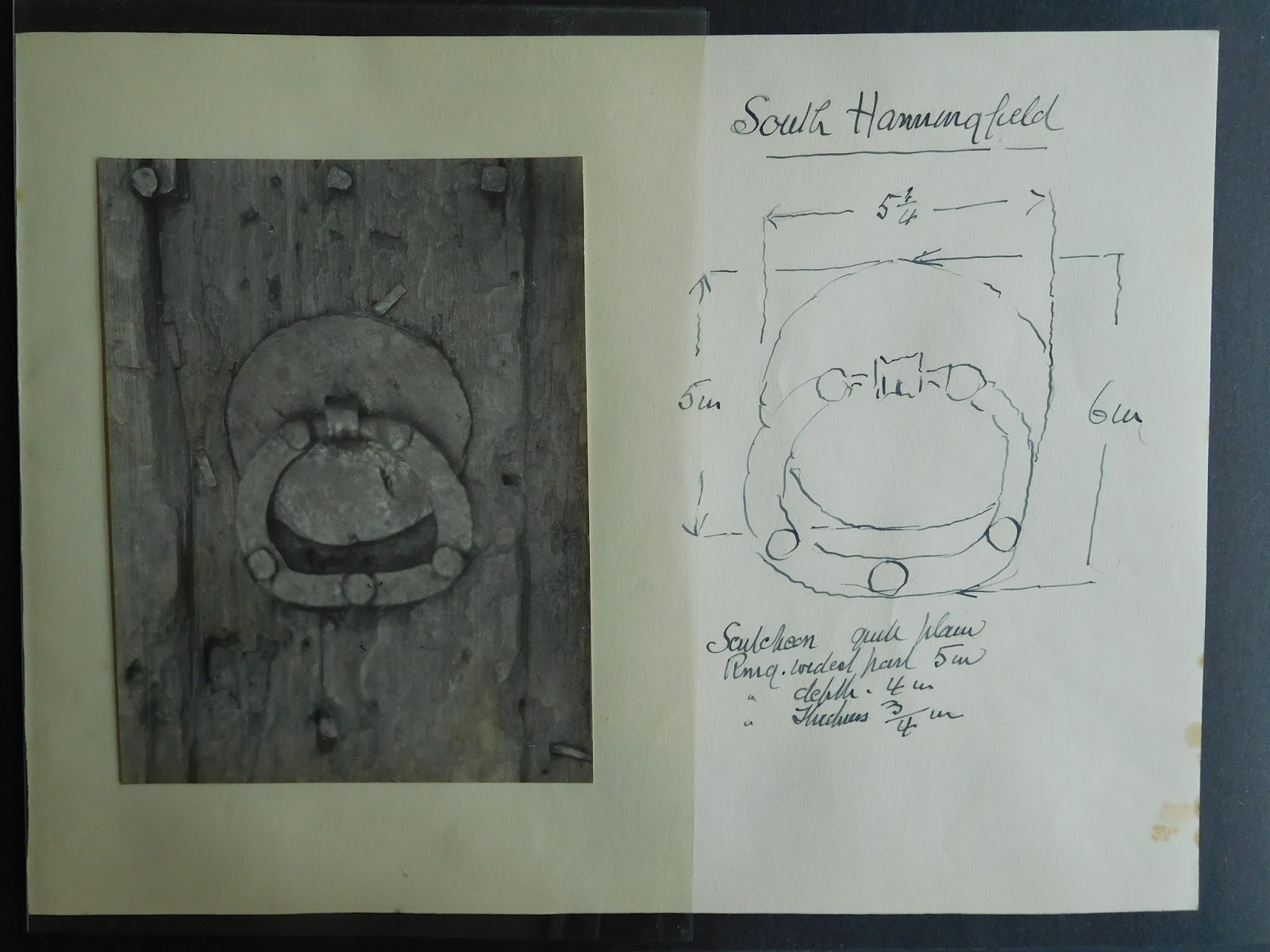
These examples are from Southchurch, South Hanningfield and Stock.


Saturday, 2 April 2016
London Museum of Water and Steam, Brentford

This item may be of interest to members of the Essex Industrial Archaeology Group:
"I am contacting you from the London Museum of Water and Steam in Brentford, home to the largest collection of water pumping
engines in the world. With a collection of seven working water pumping engines
including the world largest steam powered engine in operation we are a truly
unique site.
"The London Museum of Water and Steam welcomes groups every year from all over
Britain and indeed the world. We are able to offer a discounted rate to
visiting groups, and in order to qualify for our discounted rate groups must
consist of 10 visitors or more.
"Self-led group visit: £7.50 per person
"Guided tour: £8.50 per person
"Anna Chrystal
Education and Outreach Officer
London Museum of Water and Steam
Green Dragon Lane
Brentford
TW8 0EN
Sunday, 27 March 2016
Some Essex Closing-Rings 5
Fred Brand's project from the 1930s to locate closing rings on ancient Essex church doors. These examples are all from Saffron Walden, and are published by the Essex Society for Archaeology and History for the first time.


Tuesday, 22 March 2016
Colchester Castle Museum: Fenwick Treasure on Public View from 24 March 2016
Fenwick Treasure set to be unveiled at
Colchester Castle
|
The Fenwick
Treasure is set to be unveiled to the public from Thursday 24 March
2016.
Visitors to
the Castle will be able to view first hand a fascinating display of these
captivating archaeological finds, which are of international significance.
The objects and their stories really bring the vivid tale of the Boudican
uprising to life. Find out more about making a visit here: www.cimuseums.org.uk/fenwickhoard
|
 |
Monday, 21 March 2016
High Country History Group: Zeppelins Over Essex, 31 March 1916. Thursday 31 March 2016.

Zeppelins over Essex: 31
March 1916
Blackmore
residents had a very close shave a hundred years ago when the German Zeppelin L14
dropped bombs in the parish. The stained
glass in what is now the kitchen of St Laurence Church commemorates the night
with these words: “This window is erected as a thank-offering to Almighty God
for the protection in the Great Air Raid of March 31st 1916” (see illustration).
Andrew
Smith has researched what happened that night and tells the story in a
presentation to be given to the High Country History Group on 31 March 2016
(8pm Toot Hill Village Hall), and this summer at the Friends of St Laurence
Church Blackmore AGM.
The
Rector of Stondon Massey, Revd. Reeve recorded details in his ‘Notes for a
Parish History’: He lived at the Rectory,
what is now Stondon Massey House.
“At
11.45[p.m.] a Zeppelin dropped a series of bombs at the point where is the
junction of Stondon with the parishes of Blackmore and Kelvedon Hatch: within
easy distance of Soap House Farm. A
machine-gun had been lately established at Kelvedon Hatch to watch for the
raiders … causing it to drop the bombs hurriedly.
“Large
numbers of persons from Brentwood and the surrounding district visited the spot
next day, and the large craters caused by the bombs, some 15 feet in diameter
and varying from 3 to 9 feet in depth, were the astonishment of all. The whole saucer-like cavities were left
entirely clean by the explosion. … Nine of the thirteen holes were quickly
found: and fortunately no life was lost or building injured. … Our windows at
Stondon Rectory were violently shaken and considerable alarm was naturally
caused.
“Further
enquiry shows that the bombs dropped on March 31st fell between the
Soap House and the corner of Blackmore between the Church and Miss Barrett’s
house. Two were dropped in the lane near
the site of the old Blackmore Mill. The remaining
holes were to be found in a straight-line across the fields to Miss Barrett’s
at very short intervals. Many panes of
glass were broken in the house by the concussion.”
Four
people were killed in Braintree that night by the same Zeppelin crew. To hear the full story come along to Andrew’s
talk.
Sunday, 20 March 2016
Some Essex Closing-Rings 4
Some Essex Closing Rings
This is the title of an
unpublished portfolio of photographs taken by Fred Brand and S E Lloyd, sent to
Revd. G Montagu Benton in 1935. These examples are from Little Totham, Little Waltham and Purleigh.


Thursday, 17 March 2016
Book Sale at Morant Lecture: 19 March 2016
Members coming to the Morant Lecture at Stebbing this Saturday will be able to browse and buy the latest selection we have of surplus books. To see the list go to www.blackmorehistory.co.uk/esah.html
Wednesday, 16 March 2016
Philip Morant (1700-1770)
The biography of Philip Morant (1700-1770), written for the dedication of memorials to the Essex historian on 15 March 1966.
PHILIP MORANT, younger son of
Stephen Morant and Mary nee Filleul, was born in the St. Saviour's parish,
Jersey, on the 6th October, 1700.
Proceeding
from the Grammar School, Abingdon, Berks., he matriculated at Pembroke College,
Oxford, 17th December, 1717, and was admitted to the degree of Bachelor of
Arts, 21st September, 1721. Although Philip Morant passed for the Master of
Arts degree at Oxford he arranged to be incorporated at Sidney Sussex College,
Cambridge, taking his M.A. from that University, 10th October, 1729.
By
Letters-commissory from the Bishop of London the Bishop of Norwich admitted him
to Deacon's Orders, at St. Martin's-in-the-Fields, Westminster, on 23rd
September, 1722. Edward Gibson, Bishop of London, ordained him Priest,
20th December, 1724.
·
From
September 1722 till August 1732, Nicholas Tindal, Vicar of Great Waltham, was
assisted in his cure by the young Morant, as the account books of the Black
Chapel show, but then Caroline, Queen Regent, nominated him to the chaplaincy
of the English Episcopal Church at Amsterdam.
In quick succession there followed these preferments:
Rectory of Shellow Bowells. From 20 April 1733, to November 1734
Rectory of Broomfield: From 17 January 1734, to April 1738
Rectory of Chignal Smealey: From 19 September 1735, to April 1743
Rectory of St. Mary's, Colchester: From 9 March 1738, to April 1770
Rectory of Wickham Bishops: 21 January 1743, to October 1745
Rectory of Aldham: from 14 September 1745, to October 1770.
In
November, 1735, Mary, Dowager Countess
of Cassillis, appointed him her private
chaplain. Never did he hold
more than two benefices at one time.
On
6th February, 1739, he married Anne, daughter of Solomon
Stebbing of the Brook House,
Great Tey. Their only daughter, Anna Maria, was born 25th November,
1739; she afterwards married Thomas Astle, Keeper of the Records in the Tower.
When Mrs. Morant died, 20th July,
1767, aged 69, Morant moved to his daughter's home at Battersea Rise, London,
and it was while returning by water from the Temple to Vauxhall, en route for
South Lambeth, that he caught the chill from which he died, 25th November,
1770. He was buried beside his wife in the Old Church at Aldham and the stone
marking that spot is now re-erected in the present Aldham Church with the
Tablet presented by the Society near to it.
In the chancel of the Aldham church is the Latin Epitaph penned by
Thomas Astle, his son-in-law, while the east window of the church was placed
there as a memorial to his memory in 1854.
It was
on 20th November, 1755, that the Historian of Essex was elected to the
Fellowship of the Society of Antiquaries of London. He had published his History of Colchester in 1748 and was
preparing The History and Antiquities of
Essex, 2 vols., folio, 1760-1768.
The
Essex Archaeological Society has cared
for the grave of the historian for some years now but so that the stone might
be preserved was pleased to assist in saving this by placing it in the present
Aldham Church. To mark his long association with the
Borough of Colchester an armorial tablet is placed in the church of St.
Mary-at-the Walls, Colchester.
·
Aldham's
Church of Morant's day and the former Rectory of St. Mary-at-the-Walls,
Colchester, have been demolished but work which the historian initiated goes on
and almost two hundred years after his death his hand still guides
researchers.
JOHN S. APPLEBY, F.R.Hist.S.
Hon. Secretary,
E.A.S.
Tuesday, 15 March 2016
Morant Anniversary.
Morant Commemorations Fifty Years Ago
From the Society’s Annual
Report 1966: “The work of the Revd. Philip Morant,
M.A., F.S.A., was further remembered by the events of Tuesday, 15th March,
1966, when, at Aldham Church, The Patron of the Society [Sir John Ruggles-Brise]
unveiled a memorial tablet in Stone, commemorating the removal of the tombstone
of the historian and his wife from the older churchyard to the sanctuary of the
present church. At St. Mary-at-the-Walls Church, Colchester [now Colchester
Arts Centre] Sir John Ruggles-Brise, unveiled a carved memorial tablet of oak;
this tablet, bearing the arms of Morant, is placed in the tower
entrance. The Rt. Revd. Dr. Roderic Coote, Bishop of Colchester, Vice-President
of the Society, dedicated the tablets. The Revd. C. Philip Gilman, Rector of
Aldham, and the Revd. Ralph Stevens, Rector of St. Mary-at-the-Walls, conducted
the services in their respective parishes. The Orders of Service [now available
in digital format] included a biography of Morant written by the Hon. Secretary
[John Appleby].”
Subscribe to:
Posts (Atom)