.

Sunday, 24 July 2016

Essex Churches Then and Now

All Saints Church, Hutton, before restoration in 1873.
One of many fascinating Essex church photographs
 in the Society's collection.
'Essex Churches Then and Now' has been launched online today by the Essex Society for Archaeology and History. 

Andrew Smith, Hon. Deputy Librarian says, "We have been looking through and cataloging our archives and have come across two volumes of Essex church photographs and postcards dating from c1870 to c1910. These are important because some of the photographs pre-date Victorian church restorations, and could therefore be a unique record."

Andrew has digitised over 650 pictures in the collection and produced an index, which has just been published online.

"Publishing the list of photographs online is only the start of the process.  We would be pleased to hear from anyone with an interest in Essex churches, and are happy to share digitised copies with researchers and local history groups".

Andrew plans to visit some of the churches over the next few months and is devising a one-hour talk entitled 'Essex Churches Then and Now' which he hopes to premier in spring 2017.


Initially the photographic collection was thought to have been compiled latterly by John Edward Knight Cutts[1] (1847-1938) (see https://en.wikipedia.org/wiki/J._E._K._Cutts ), member of the Essex Archaeological Society from 1883, and church architect (see http://archiseek.com/tag/j-e-k-cutts/ ) whose name is and date is credited to later photographs in the collection.  According to The Buildings of England: Essex by Pevsner / Bettley (2007) J.E.K. Cutts was architect of the now demolished St Augustine’s Church, Lower Dovercourt, 1883-84, and the Arts Centre, formerly the Great Burstead Board School, in Billericay, 1877-78.  All Saints, Dovercourt, restored 1897-98; St Paul Church, Elmstead Market, now a house, built 1908; and, St Mary, Little Oakley, now a house, restored 1895-1902 are all the work of J.E.K. & J.P. Cutts.

It was tempting to think that the work was begun by Edward Cutts.  Having compared the pencil labelling to the handwriting in the EAS Minute Book during the time Cutts served as Secretary, it is clear that the labelling is not his work.  Equally there are errors in labelling: South Benfleet should be North Benfleet, Coopersale should read Theydon Garnon, Stock should read Laindon, Blackmore End should read Stisted, the omissions of East Mersea, Stondon Massey and Chigwell.  Warley is, in fact, Great Warley not Little Warley, a church demolished in the 1950s.  The photograph labelled “Litt. Oakley ?” is clearly not Little Oakley but Ugley[2], and is compelling because Cutts was its restorer.  On the same page a corrected entry from Great to Little Oakley is in fact, from Internet images research, Great Oakley.  There is therefore sufficient evidence to determine that the volumes did not belong to the Cutts family.

The various sizes of photographs, as well as the revelation that copies appear elsewhere, suggest that the mystery compiler was not the photographer but acquired copies probably from perhaps other gentlemen members of the Society, sharing the same taste and concern to record changes in church buildings.  The contents list below gives sizes for some of the photographs, which may indicate the same photographer or equipment employed.

“THERE is no need to stress the importance to the ecclesiologist of photographs and reliable drawings of churches before they were subjected to nineteenth-century reparation.” (Benton, TEAS n.s. xxiv).  Benton makes reference to the Chancellor collection of photographs in the Society’s collection, now at the Essex Record Office.

A further important collection of Essex prints, exquisite sketches, photographs and newspaper cuttings in the name of Probert (ERO A13366) was deposited by the Society at the Essex Record Office in 2012.

The collections of photographs may be supported by contemporary narrative: Suckling (1846), Buckler (1856), Chancellor (as published in the Transactions of the Society, and Essex Review), and manuscript notes by King (1856-93) and C. F. D. Sperling.


[1] On the Membership List in 1915, Cutts was living in Ontario, Canada having retired there in 1912.  His parents were Edward Lewes Cutts (1824-1901), clergyman and founder of E.A.S., and Mariann Elizabeth Knight (see http://www.vangoozen.ca/bios.html ).
[2] Identified by Martin Stuchfield who sent an identical modern photograph following the Society’s AGM on 25 June 2016.

Friday, 22 July 2016

Archives Update

The Essex Society for Archaeology and History has this week delivered to the Essex Record Office its archives in series S/LIB/9 (with the exception of S/LIB/9/20-25,48-49) and S/SEC/4/1.  Content will be reviewed with the intention of deposit on permanent loan.

Sunday, 10 July 2016

Dengie From The Air: The Blackwater as a London Airport

A London Airport we never had.

Following the 2nd World War the Government sought to improve transatlantic and long distant air transport.  Flying boats were considered suitable and Saunders-Roe were approached in 1945 to design a suitable plane.  The following year they received a contract for three of what were to be the largest flying boats – the S.R. 45 ‘Princess’. 

Steps were then taken to find a suitable site for a Flying Boat air port to serve London.  The Chichester area and the Blackwater were the two suggested locations and assessments were made in 1947 of their suitability.  Initial conclusions stated :

“At  Chichester, the ideal terminal cannot be provided without the engineering difficulties of building on reclaimed land.  At Blackwater, it cannot be provided without a larger terminal basin and mooring area than is proposed in the Blackwater Survey Report.  If neither of these courses should prove practical, then, in terms of taxying distances, Blackwater, with a terminal at Bradwell and Maintenance and M.O.S. at Ramsey, would be preferable to Chichester …

Extendibility of Alighting Area.  -  Chichester, once built could not be extended, whereas the length of run at Blackwater is practically limitless.

Availability.  -  Chichester would not be available for use until the end of a lengthy development period.  On the other hand, most of the alighting area at the Blackwater is available now and would be so during the development period.”

The three terminal sites suggested were at Osea Island, Ramsey Wade between Stansgate and Ramsey Island, St. Lawrence, and Bradwell Creek. The Bradwell basin would have utilised an enlarged Creek. At Ramsey it would have occupied the Wade, previously sealed off from the Blackwater in 1815. Both basins would have been deepened by excavation and at Ramsey Wade the sea wall demolished to gain access. 

The plans do not indicate where the Osea basin might have been but the terminal would have been on the island itself with a new causeway constructed to give road access towards the A12.

It was envisaged that the then redundant Bradwell Bay aerodrome could act as a feeder airport for the south bank sites.  They estimated that the road journey from these two sites would take 3 hours compared with today’s 1½ hours.

Consultations were held between several government ministries and local authorities.  Maldon’s M.P. Tom Driberg also requested to be kept informed.

One consultee put forward the Medway Estuary as a better alternative – a precursor to ‘Boris Island’ ?

The scheme came to nothing as it became obvious that land based airfields would cater more economically and safely.  Only one of the Princess aircraft ever flew, in 1952.

Small sea planes did operate on the Blackwater during the First World War in conjunction with H.M.S. Osea fast motor boat base.  Sea planes may still return to the Blackwater as there is currently a proposal to operate a service between Osea and small airports around London.

“The Dengie Hundred in the Air” is this year’s exhibition to be held at St Lawrence Heritage Church from 9th July until 11th September, Saturday and Sunday afternoons.

Sources.
TNA BT 217/1777   River Blackwater, Essex: proposed flying boat base
Maldon & Burnham Standard March 2016


Friday, 1 July 2016

Ingatestone: Somme Commemoration

Blackmore Area Local History: Ingatestone: Somme Commemoration: The events of the first day of the Battle of the Somme were remembered at 8am today with a simple service by the War Memorial to mark the centenary of its commencement. Gordon J W Francis, born 1891 at 21 High Street, died 1 July 1916. Muffled bells were rung in remembrance of the one-time bell ringer.

1 July 1916: The Opening Day of the Battle of the Somme

The Revd. Edward Reeve, rector of Stondon Massey, kept a diary called ‘Notes for a Parish History.  In it he wrote his observations of the First World War from his study in what is now Stondon Massey House.


“1st July 1916: As I write, the reverberation of the great guns and explosion of mines are shaking the windows of the Rectory and of all the other houses, I suppose, in the southern and south-eastern counties of England.  There is evidently a very heavy bombardment in progress."

Thursday, 30 June 2016

100th Anniversary of the Battle of the Somme

100th Anniversary of the Battle of the Somme

A 2-minute national silence is to be held at 07:28hrs on Friday 1 July 2016 to mark the 100th Anniversary of the Battle of the Somme.
 
07:30hrs marks the moment that many men went over the top 100 years ago. 19,240 men lost their lives on the first day.

Monday, 27 June 2016

Battle of the Somme Commemoration Service at North Weald Airfield: Friday 1 July 2016. 7.30am

A service to commemorate the first day of the Battle of the Somme will be held at North Weald Airfield at 7.30am on Friday 1 July 2016. For more information follow this link: https://www.evensi.uk/battle-of-the-somme-commemoration-service-north-weald/180362951 .   The airfield itself is 100 years old this year, constructed in 1916 to defend the enemy from attacking London.

Tuesday, 21 June 2016

Fingringhoe. The unsolved mystery of Ada Constance Kent

I'm working on a documentary for BBC Radio 4 looking into the disappearance and possible death of Ada Constance Kent from Finringhoe in 1939. 
If you're not familar with the story there's a little (probably inaccurate) write up of it here http://coolinterestingstuff.com/the-unexplained-mystery-of-ada-constance-kent-the-skeleton-in-the-bedroom

I've managed to gether some contemporary newspaper suttings about the case, but I'd love to know if there's anyone who was at all involved with Ada Kent who's still alive - any friends or relatives.  

If anyone has more information on this case than is availale online then it'd be great to speak with them. Or if there are any records or newspaper articles it would be useful to look at, I'm keen to do so. 

Looking forward to hearing from you if you think there's anything to go on!

With thanks and best wishes,
Nadia 

Sunday, 12 June 2016

Newsletter (Summer 2016) and Notice of AGM

Members will have received through the post notice of the Annual General Meeting of the Essex Society for Archaeology and History on Saturday 25 June, 2pm, at Colchester Castle.  This came with the Summer 2016 edition of the Newsletter (No. 178) issued earlier than usual. Items this time include:
- From The President.  Adrian Corder-Birch mentions the forthcoming AGM, our new membership leaflet, the issue of Volume 5 of our Transactions with Volumes 6 & 7 having material in hand for the new editor, the change of names of Committees to reflect more accurately what they are doing (Library Committee is now Library and Archives Committee, Publications Committee is now Publications and Research Committee), the placing of our Morant print in the Library, and the appointment of Zoe Quinn as our Publicity Officer.
- Major Brinson at Paestum: follows up a previous item on the archaeological work of J.E.S. Brinson during the Second World War in Italy
- VCH Southend Project: the plan for a "short" publication
- Suspension of the Harwich-Shotley Gate Ferry
- The Blackwater as a London Airport: proposal following the Second World War
- Saving The Century: Victorian Society Exhibition in 2015
- The Last Years of the River Crouch Ferries
- The Society Archives: The Sellers give us the Sixties (conclusion)
- A Mabbitt Contribution to the Society Archives: The Medieval Feast which celebrates the Society's centenary in 1953
- The Harwich Redoubt and Victoria County History
- Sir Edward Bysshe's Visitation of Essex 1664-68
- The Christy Family and its link to the cradle of Industrial Revolution
- Leverton Charities, Waltham Abbey
- Some Essex Closing Rings
- Wolfstones, Dogstones and Quernstones
- Dew Ponds in Essex?
- Morant Lecture at Stebbing, 19 March 2016
- Society Visit to Great Dunmow Maltings, 16 April 2016
- Ulting Wick and Ulting Church
- ESAH Digitisation Project
- Events in Essex
- Obituary: Kenneth Neale (1922-2016)

Friday, 10 June 2016

Friends of St Laurence, Blackmore. Zeppelins Over Essex. Thursday 16 June 2016

'Zeppelins Over Essex: 31 March 1916' is a talk to be given by Andrew Smith, with audience participation, to mark the 100th anniversary of the great Zeppelin raids across Blackmore and Essex during the First World War.  

Thursday 16 June 2016
7.45pm
The Priory Church of St Laurence, Blackmore

The talk follows the AGM of the Friends of St Laurence.  Admission free, followed by refreshments.

Sunday, 22 May 2016

Transactions. Series 4. Volume 5

Just published. Available £15 inc. P&P to UK address.

Essex Society for Archaeology and History
Transactions. Fourth Series. Volume 5 (2014)
(220 pages)

Contents:
An Early Bronze Age Beaker domestic site: Excavations at 105-109 New Road, Rainham, London Borough of Havering:  R Bull … 1
A Prehistoric landscape at Langford Hall, near Heybridge: Excavations 1995-96:  M Roy & E M Heppell … 19
Excavations at Earls Hall Farm, St Osyth:  Nuala C Woodley … 37
Continuity and change in the mid Chelmer Valley – archaeological excavations at Old Hall and Generals Farm, Boreham, 2007:  M Germany … 45
A Late Iron Age red hill and saltern at Bradwell on Sea:  T Ennis … 103
Late Iron Age, Roman and medieval occupation at Letch’s Yard, 109 High Street, Braintree:  T Ennis … 103
The gardens at Moulsham Hall: Excavations at Princes Road, Chelmsford, 1996-97:  E M Heppell … 118
The stationary steam engine in Essex before 1840: A Phillips … 133
Historic Buildings in Essex (Essex Historic Buildings Group):  Essex Tree-Ring Dates; Aveley St Michael; Sheering Church Nave Roof; Baythorne Hall, Birdbrook. A Raised Aisle Hall Manor House built in 1341; The Stockwell Restaurant, the former Stockwell Arms Public House, Colchester; Bullocks Cross, Coggeshall; Parsonage Farm, School Lane, Broomfield, Chelmsford; The Listed Barns at Coleman’s Farm, Theydon Mount:  David Andrews … 142
Heybridge Hall and the Freshwater family:  K Bruce … 182
Ancient and modern, developing landscape of South Essex: A review of four recent monographs: (i) Landscape and Prehistory of the East London Wetlands: investigation along the A13 DBFO road scheme, Tower Hamlets, Newham and Barking & Dagenham, 2000-2003 by Elizabeth Stafford with Damian Goodburn and Martin Bates, 2012; (ii)By River, Fields and Factories: The Making of the Lower Lea Valley: archaeological and cultural heritage investigations on the site of the London 2012 Olympic and Paralympic Games by Andrew B Powell, 2012; (iii) London Gateway, Iron Age and Roman Salt Making in the Thames Estuary: Excavation at Stanford Wharf Nature Reserve, Essex by Edward Biddulph, Stuart Foreman, Elizabeth Stafford, Dan Shanbie & Rebecca Nicholson, 2012; (iv)  Thames Holocene: A geoarchaeological approach to the investigation of the river floodplain for High Speed 1, 1994-2003 by Martin Bates and Elizabeth Stafford, 2013:  Nigel Brown … 190
Shorter Notes
A possible Roman tile kiln at Prentice Place, Carters Mead, Harlow:  S Mounce & P Bradley … 200
The misplaced masterpiece – a reassessment of the Berryfield  mosaic [Colchester}:  P J Wise … 202
‘New’ Anglo-Saxon charters of Barking Abbey:  J Kemble … 204
Collegium Chronologicum:  H Eiden … 210
Book Reviews
The Red Hills of Essex: Studying Salt in England: Anwen Cooper … 212
Elizabeth de Burgh, Lady of Clare (1295 – 1360). Household and other records:  Katherine Schofield … 214
Beeleigh Abbey: A Guide and History :  Christopher Starr … 214
The Borough of Maldon 1688-1800. A Golden Age:  Christopher Starr … 215
Bricks, Buildings and Transport. A History of Mark Gentry, the Hedingham Red Brick Industry, Buildings, Road, and Rail Transport:  David Andrews … 215
A Caring County? Social Welfare in Hertfordshire from 1600:  Herbert Eiden … 216
Essex Bibliography: Andrew Phillips & Paul Sealey … 217

Thursday, 21 April 2016

West Essex Archaeological Group. Events

 SUMMER EVENTS

WEST ESSEX ARCHAEOLOGICAL GROUP

Monday 9th May
Rudge Memorial Lecture: ‘The Thames at War’, illustrated talk by Gustav Milne, Museum of London Archaeology, 7.45 p.m., School Hall, Woodford County High School, High Road, Woodford Green.  Free entry and refreshments.

16 – 17; 23 – 24; and 30 – 31 July: Excavation Taster Weekends  at Copped Hall near Epping, aimed at complete beginners.  For more information and bookings, visit www.weag.org.uk


13 – 17 and 27 -31 August: Five-Day Field Schools, ongoing excavation of Tudor grand-house at Copped Hall, near Epping.  For full details and bookings , visit www.weag.org.uk

Wednesday, 20 April 2016

Gaps in 'Current Archaeology'? We can help.

Current Archaeology.  We have received a complete run of Current Archaeology from #1 to #302 (May 2015) which we do not need for our Library.  Do you have gaps on your bookshelf or does your archaeological or historical institute, university or group have the same problem?  Each item only 30p + P&P.  Contact us.  We might be be able to help.

Monday, 18 April 2016

Newsletter (Spring 2016)

The Spring 2016 edition of the Newsletter (NL177) arrived through the post for many members of the Essex Society for Archaeology and History on Saturday.  Readers will immediately notice that the front cover is different, illustrating six Roman coins which were stolen from Chelmsford Museum in January 2016 and remain, alas, unrecovered.  Why someone would steal these is a question that does not warrant comment, other than to reflect what the curator of the Fitzwilliam Museum Cambridge said in response to the jailing of the gang responsible that the Chinese artefacts, not found, belonged in a sense to everyone.  

The Newsletter is another 24-page edition, the contents of which include:
- From The President.  Adrian Corder-Birch mentions that 'Excavations along the M25', occasional paper is available to members with additional copies on sale to the public; the work of Philip Crummy and Colchester Archaeological Trust in connection with the Fenwick Treasure, now on display at Colchester Museum, and excavations of the Roman arcade in the High Street; and, the forthcoming Annual General Meeting to be held at the Castle. (Papers will be circulated separately.)
- Coins Stolen from Chelmsford Museum
- Heritage Crime Investigation Rumbles a Dutch Deception
- A Vengeful Saint
- Essex Utopias?
- Society Visit to Jaywick Martello Tower, 26 February 2016
- John Booth, Essex Antiquary - a postscript
- Roman Arcade Attracts A Crowd
- Harlow Temple Digitisation Project: an update
- Excavations at Pleshey
- Henry VIII's Jericho?
- Major Brinson's Italian Excavations
- Eddington Engineering in Chelmsford
- Archaeologists explore Envrironment Agency's LIDAR
- The Society Archives: The Sellers give us the Sixties
- ESAH Finds New Home for Pottery Fragments
- Essex Churches Project
- Essex seen from Elsewhere
- Library Purchases and Donations
- Vernacular Architecture
- The Meaning of Mucking
- Events In Essex
- Readers Letters
- Essex Journal
- Book Reviews

Sunday, 17 April 2016

Some Essex Closing-Rings 8

Concluding the series of photographs presented to the Revd. G Montagu Benton by Fred Brand in 1935 of Essex closing-rings on church doors, these examples come from White Roding (White Roothing), Widdington and Witham.


Tuesday, 12 April 2016

The Hyde, Ingatestone: Eulogy For A Country House School

The Hyde, Ingatestone, was the seat of John Disney the first President of the Essex Society for Archaeology and History.  During the twentieth century until gutted by fire it was a school.

EULOGY FOR A COUNTRY HOUSE SCHOOL

From David Archer Wright:

Discovering this article and other references to The Hyde Ingatestone, immediately evoked suppressed memories of long past familiarities.

As country houses go, The Hyde, although by no means architecturally outstanding, was certainly a property worth cataloguing. The splendidly re-structured Palladium style great hall with finely turned Tuscan columns and grand sweeping staircase, even during latter day school use, was impressively adorned with fascinatingly complementing period artefacts:  time dulled oil paintings in ornate guilt frames, dusty doe eyed stag's heads, stuffed owls in glass domes and a fine eighteenth century long case clock.

As a pupil spending my formative years here, I also recall the rows of servants' bells in the lengthy corridor leading between lofty kitchens and wood panelled dining room, summoning past eras of wealthier times. 

Privileged highlights amidst the dull chalk dusted lessons were officially escorted introductions to the dizzying heights of the rooftop balustrades or the dark dank depths of the cellars. In the stable block heavy archaic accumulators were clues to an earlier, more prosaic source of electricity.

Most exciting of all was a secret room entered by way of an opening bookcase, its subtly hinged shelves lined from floor to ceiling with false leather bound first editions. The wide oak floorboards in front of the books maintained a highly lustred finish with the enthusiastic aid of fleet footed boys organised into skating parties, fiercely sliding up and down in outsized football socks. In a room on the third floor (no doubt out of bounds) silent stacks of redundant cast iron bedsteads remained as inherited evidence of the house's use as a military hospital during WWI. 

The date 1719 is for some reason embossed on my memory as surely as it was on the cast iron tops of guttering down pipes beside certain bricked up windows.

As a school, typical 'Basil Fawltyesque' ideology was nurtured from an early age; high moral values indoctrinating tender young minds. We were systematically encouraged to feel pride in being British: superior.  Psychology was a load of tommy rot.  Anyone speaking with a regional accent was a yob. Break times in the shrubbery provided initiation and intensive instruction into the extra curricula activities of fighting smoking and bullying.

The greatest tribute payable to the Hyde School, its highest possible accolade, most praiseworthy of progenies and ultimate achievement, is the fact that it was burnt down. It bequeaths a legacy of ploughed up arable fields.

Sunday, 10 April 2016

Some Essex Closing-Rings 7

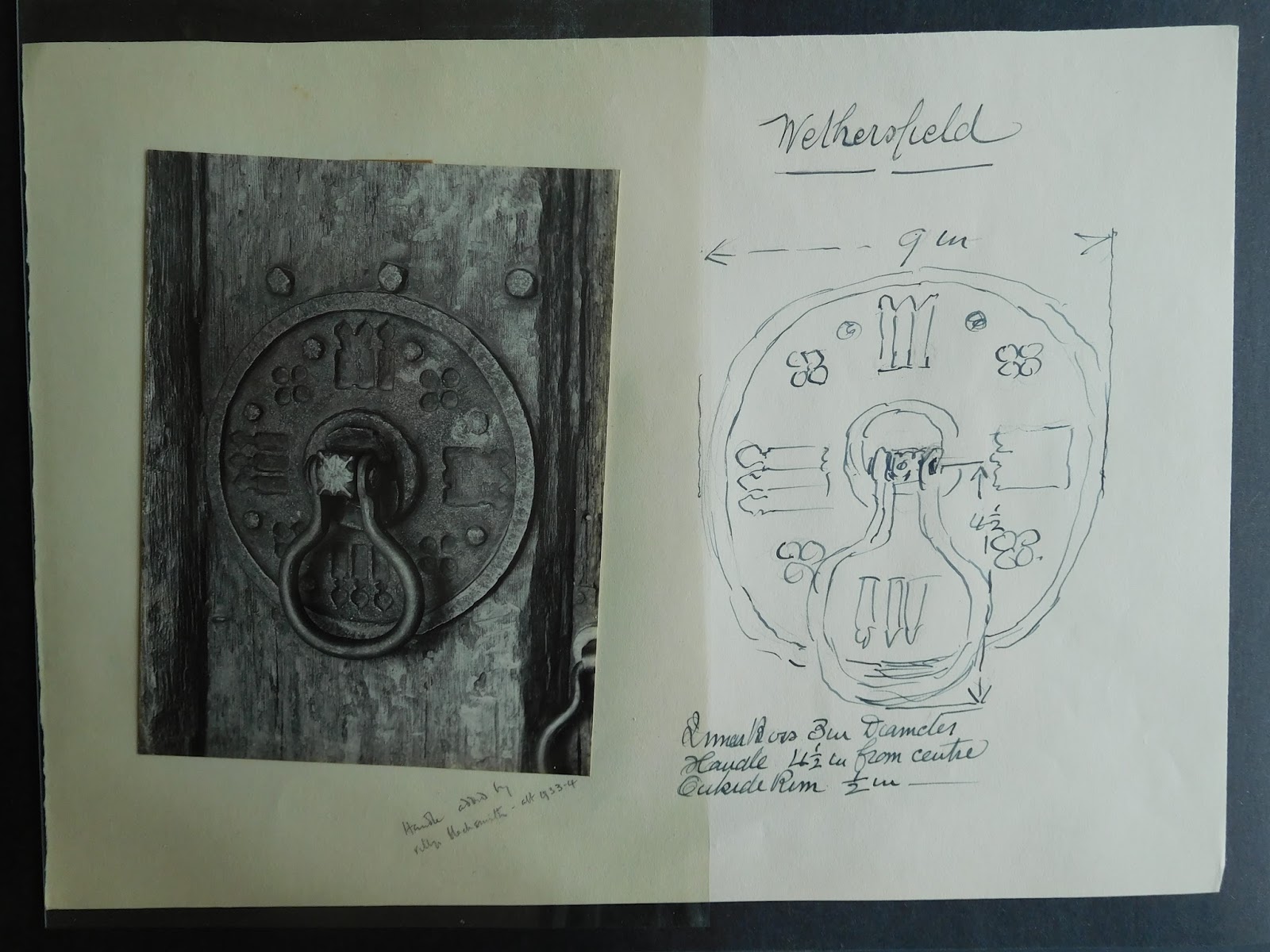
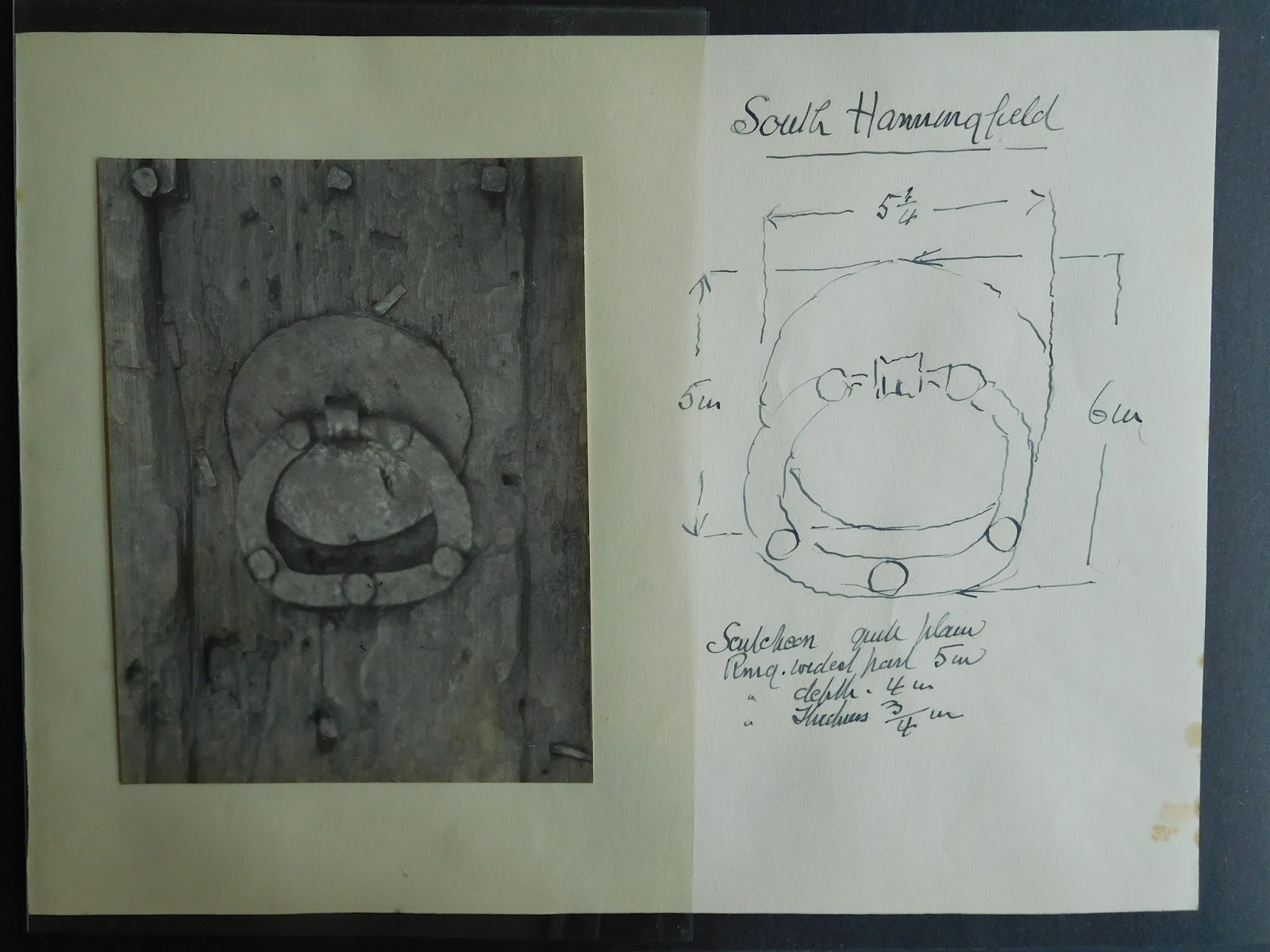
Continuing the series of Essex Closing-Rings photographed by Fred Brand in the 1930s. These examples are from the churches at Takeley, Terling, West Hanningfield and Wethersfield.


Tuesday, 5 April 2016

Zepfest Film Presentation: Friday 8 April 2016

Zepfest

The forced landing of the German Zeppelin L33 at 1.20am on 24 September 1916 at Little Wigborough is commemorated by Zepfest (http://www.zepfest.net/#home ), now National Trust property, on Saturday 24 and Sunday 25 September 2016.  Tickets for the main event go on sale in due course. 

In the meantime, on Friday 8 April 2016 starting at 7.30pm at Abbotts Hall Meeting Room, Great Wigborough, CO5 7RZ, there will be a film presentation. For more see http://winstred100.org/2016/03/zepfest-film-presentation/


Sunday, 3 April 2016

Some Essex Closing-Rings 6

The Essex Society for Archaeology and History continues the online publication of Fred Brand's photographs of Essex church door closing rings from the 1930s, which has recently been received and assigned reference S/LIB/9/51 in the archives.

These examples are from Southchurch, South Hanningfield and Stock.


Saturday, 2 April 2016

London Museum of Water and Steam, Brentford


This item may be of interest to members of the Essex Industrial Archaeology Group:

"I am contacting you from the London Museum of Water and Steam in Brentford, home to the largest collection of water pumping engines in the world. With a collection of seven working water pumping engines including the world largest steam powered engine in operation we are a truly unique site.


"The London Museum of Water and Steam welcomes groups every year from all over Britain and indeed the world. We are able to offer a discounted rate to visiting groups, and in order to qualify for our discounted rate groups must consist of 10 visitors or more.

"Self-led group visit:  £7.50 per person

"Guided tour:  £8.50 per person

"Anna Chrystal
Education and Outreach Officer

London Museum of Water and Steam
Green Dragon Lane
Brentford
TW8 0EN

Sunday, 27 March 2016

Some Essex Closing-Rings 5

Fred Brand's project from the 1930s to locate closing rings on ancient Essex church doors. These examples are all from Saffron Walden, and are published by the Essex Society for Archaeology and History for the first time.


Tuesday, 22 March 2016

Colchester Castle Museum: Fenwick Treasure on Public View from 24 March 2016

Fenwick Treasure set to be unveiled at Colchester Castle


The Fenwick Treasure is set to be unveiled to the public from Thursday 24 March 2016.
Visitors to the Castle will be able to view first hand a fascinating display of these captivating archaeological finds, which are of international significance. The objects and their stories really bring the vivid tale of the Boudican uprising to life. Find out more about making a visit here: www.cimuseums.org.uk/fenwickhoard
treasure

Monday, 21 March 2016

High Country History Group: Zeppelins Over Essex, 31 March 1916. Thursday 31 March 2016.

Zeppelins over Essex: 31 March 1916

Blackmore residents had a very close shave a hundred years ago when the German Zeppelin L14 dropped bombs in the parish.  The stained glass in what is now the kitchen of St Laurence Church commemorates the night with these words: “This window is erected as a thank-offering to Almighty God for the protection in the Great Air Raid of March 31st 1916” (see illustration).

Andrew Smith has researched what happened that night and tells the story in a presentation to be given to the High Country History Group on 31 March 2016 (8pm Toot Hill Village Hall), and this summer at the Friends of St Laurence Church Blackmore AGM.
  
The Rector of Stondon Massey, Revd. Reeve recorded details in his ‘Notes for a Parish History’:  He lived at the Rectory, what is now Stondon Massey House.

“At 11.45[p.m.] a Zeppelin dropped a series of bombs at the point where is the junction of Stondon with the parishes of Blackmore and Kelvedon Hatch: within easy distance of Soap House Farm.  A machine-gun had been lately established at Kelvedon Hatch to watch for the raiders … causing it to drop the bombs hurriedly.

“Large numbers of persons from Brentwood and the surrounding district visited the spot next day, and the large craters caused by the bombs, some 15 feet in diameter and varying from 3 to 9 feet in depth, were the astonishment of all.  The whole saucer-like cavities were left entirely clean by the explosion. … Nine of the thirteen holes were quickly found: and fortunately no life was lost or building injured. … Our windows at Stondon Rectory were violently shaken and considerable alarm was naturally caused.

“Further enquiry shows that the bombs dropped on March 31st fell between the Soap House and the corner of Blackmore between the Church and Miss Barrett’s house.  Two were dropped in the lane near the site of the old Blackmore Mill.  The remaining holes were to be found in a straight-line across the fields to Miss Barrett’s at very short intervals.  Many panes of glass were broken in the house by the concussion.”


Four people were killed in Braintree that night by the same Zeppelin crew.  To hear the full story come along to Andrew’s talk.

Sunday, 20 March 2016

Some Essex Closing-Rings 4

Some Essex Closing Rings


This is the title of an unpublished portfolio of photographs taken by Fred Brand and S E Lloyd, sent to Revd. G Montagu Benton in 1935.  These examples are from Little Totham, Little Waltham and Purleigh. 


Thursday, 17 March 2016

Book Sale at Morant Lecture: 19 March 2016

Members coming to the Morant Lecture at Stebbing this Saturday will be able to browse and buy the latest selection we have of surplus books.  To see the list go to www.blackmorehistory.co.uk/esah.html

Wednesday, 16 March 2016

Philip Morant (1700-1770)

The biography of Philip Morant (1700-1770), written for the dedication of memorials to the Essex historian on 15 March 1966.

PHILIP MORANT, younger son of Stephen Morant and Mary nee Filleul, was born in the St. Saviour's parish, Jersey, on the 6th October, 1700.

Proceeding from the Grammar School, Abingdon, Berks., he matriculated at Pembroke College, Oxford, 17th December, 1717, and was admitted to the degree of Bachelor of Arts, 21st September, 1721. Although Philip Morant passed for the Master of Arts degree at Oxford he arranged to be incorporated at Sidney Sussex College, Cambridge, taking his M.A. from that University, 10th October, 1729.

By Letters-commissory from the Bishop of London the Bishop of Norwich admitted him to Deacon's Orders, at St. Martin's-in-the-Fields, Westminster, on 23rd September, 1722. Edward  Gibson, Bishop of London, ordained him Priest,  20th  December,  1724.                                                                                           ·

From September 1722 till August 1732, Nicholas Tindal, Vicar of Great Waltham, was assisted in his cure by the young Morant, as the account books of the Black Chapel show, but then Caroline, Queen Regent, nominated him to the chaplaincy of the English Episcopal Church at Amsterdam.

In quick succession there followed these preferments:
Rectory of Shellow Bowells.  From 20 April 1733, to November 1734
Rectory of Broomfield: From 17 January 1734, to April 1738
Rectory of Chignal Smealey: From 19 September 1735, to April 1743
Rectory of St. Mary's, Colchester: From 9 March 1738, to April 1770
Rectory of Wickham Bishops: 21 January 1743, to October 1745
Rectory of Aldham: from 14 September 1745, to October 1770.

In November,  1735, Mary, Dowager Countess of Cassillis, appointed  him her private chaplain.   Never did he hold more than two benefices at one time.

On 6th February, 1739, he married Anne, daughter of  Solomon  Stebbing of the  Brook  House,  Great Tey. Their only daughter, Anna Maria, was born 25th November, 1739; she afterwards married Thomas Astle, Keeper of the Records in the Tower.

When Mrs. Morant died, 20th July, 1767, aged 69, Morant moved to his daughter's home at Battersea Rise, London, and it was while returning by water from the Temple to Vauxhall, en route for South Lambeth, that he caught the chill from which he died, 25th November, 1770. He was buried beside his wife in the Old Church at Aldham and the stone marking that spot is now re-erected in the present Aldham Church with the Tablet presented by the Society near to it.   In the chancel of the Aldham church is the Latin Epitaph penned by Thomas Astle, his son-in-law, while the east window of the church was placed there as a memorial to his memory in 1854.

It was on 20th November, 1755, that the Historian of Essex was elected to the Fellowship of the Society of Antiquaries of London. He had published his History of Colchester in 1748 and was preparing The History and Antiquities of Essex, 2 vols., folio, 1760-1768.

The Essex Archaeological  Society has cared for the grave of the historian for some years now but so that the stone might be preserved was pleased to assist in saving this by placing it in the present Aldham Church. To mark his long association with the Borough of Colchester an armorial tablet is placed in the church of St. Mary-at-the Walls, Colchester.                                                          ·

Aldham's Church of Morant's day and the former Rectory of St. Mary-at-the-Walls, Colchester, have been demolished but work which the historian initiated goes on and almost two hundred years after his death his hand still  guides  researchers.

JOHN S. APPLEBY, F.R.Hist.S.
Hon. Secretary, E.A.S.

Tuesday, 15 March 2016

Morant Anniversary.

Morant Commemorations Fifty Years Ago


From the Society’s Annual Report 1966: “The work of the Revd. Philip Morant, M.A., F.S.A., was further remembered by the events of Tuesday, 15th March, 1966, when, at Aldham Church, The Patron of the Society [Sir John Ruggles-Brise] unveiled a memorial tablet in Stone, commemorating the removal of the tombstone of the historian and his wife from the older churchyard to the sanctuary of the present church. At St. Mary-at-the-Walls Church, Colchester [now Colchester Arts Centre] Sir John Ruggles-Brise, unveiled a carved memorial tablet of oak; this tablet, bearing the arms of Morant, is placed in the tower entrance. The Rt. Revd. Dr. Roderic Coote, Bishop of Colchester, Vice-President of the Society, dedicated the tablets. The Revd. C. Philip Gilman, Rector of Aldham, and the Revd. Ralph Stevens, Rector of St. Mary-at-the-Walls, conducted the services in their respective parishes. The Orders of Service [now available in digital format] included a biography of Morant written by the Hon. Secretary [John Appleby].”

Monday, 14 March 2016

Morant Lecture at Stebbing. Saturday 19 March 2016

Friends Meeting House, Stebbing
The next meeting of the Essex Society for Archaeology and History will be held at 2pm on Saturday 19 March 2016. The venue: The Friends Meeting House, Stebbing.  This will be the annual Morant Lecture held in honour of the great Essex historian.  It will be a talk about the village of Stebbing and the various projects that are happening, followed by a tour of the village then refreshments.  Stebbing is a small village in north Essex situated to the north of the Roman road - Stane Street. Stebbing has a Grade I listed church and the earthworks of a medieval castle.

Sunday, 13 March 2016

Some Essex Closing-Rings 3

Some Essex Closing Rings


This is the title of an unpublished portfolio of photographs taken by Fred Brand and S E Lloyd, sent to Revd. G Montagu Benton in 1935.  In February 2016 it was given to the Society by the family of the late Kenneth Mabbitt and added to our archives pro tem (as S/LIB/9/51).  Thirty-one items have been digitised, 29 of which are photographs of closing rings on Essex church doors with a sketch showing measurements alongside. Frederick Joseph Brand (1857-1939) had been a member of EAS since 1899. His obituary appeared in TEAS n.s. 23, p192-195, in which Benton mentions his enthusiastic interest in the topic. “He was engaged on this survey, which was nearing completion, practically up to the outbreak of war”.  He took many photographs on the Society’s excursions and was “usually the last to regain his seat on the motor-coach”.  Stanley E Lloyd, of Goodmayes, has been a member of EAS since 1923. 

Examples here from Great Yeldham, Hempstead and Heybridge.


Sunday, 6 March 2016

Some Essex Closing-Rings 2

Some Essex Closing Rings

This is the title of a portfolio of photographs taken by Fred Brand and S E Lloyd, sent to Revd. G Montagu Benton in 1935.  In February 2016 it was given to the Essex Society for Archaeology and History by the family of the late Kenneth Mabbitt and added to our archives pro tem (as S/LIB/9/51).  Thirty-one items have been digitised, 29 are photographs of closing rings on Essex church doors with a sketch showing measurements alongside. Frederick Joseph Brand (1857-1939) had been a member of EAS since 1899. His obituary appears in TEAS ns XXIII p192-195, in which Benton mentions his enthusiastic interest in the topic. “He was engaged on this survey, which was nearing completion, practically up to the outbreak of war”.  He was often busy taking photographs on the Society’s excursions and “usually the last to regain his seat on the motor-coach”.  Stanley E Lloyd, of Goodmayes, has been a member of EAS since 1923.

Illustrated here: East Horndon, Eastwood, Elsenham, Great Waltham.